- Proudly Made in the USA

Choosing fire rated glass in 2026 is not simply a matter of selecting the highest fire-resistance number. The right product must match the wall, door, frame, and installation method. It should also suit the building’s design, daylight needs, acoustic targets, and maintenance plan. A glass panel may perform well in a laboratory but fail to meet expectations when paired with an unsuitable frame. Small details matter.
In practical project reviews, I look for current test reports, certification scope, product markings, and installation instructions before comparing prices. The classification can include integrity, insulation, or both, depending on the tested system and local requirements. Terminology also varies between regions, so assumptions create risk. A 2026 specification should be checked against the authority having jurisdiction and the project’s approved fire strategy. Do not rely on a brochure alone.
Think beyond the sample.
Consider a stairwell with strong afternoon sunlight, a corridor exposed to trolley impacts, or a door used hundreds of times daily. These conditions influence glass selection and long-term reliability. Laminated, wired, or transparent ceramic products may offer different visual and performance characteristics. Yet the most attractive option is not always the most appropriate one. I have seen specifications become overly confident because they focused on glass alone. That is a weakness worth acknowledging. The complete tested assembly deserves equal attention. This guide explains how to compare fire rated glass with clearer evidence, practical judgment, and fewer costly surprises.
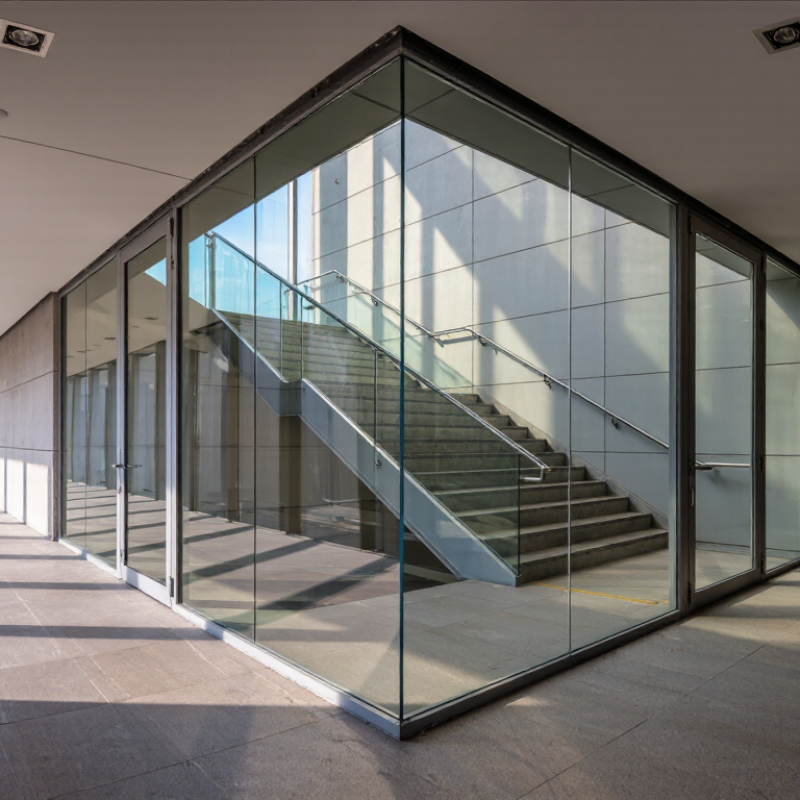
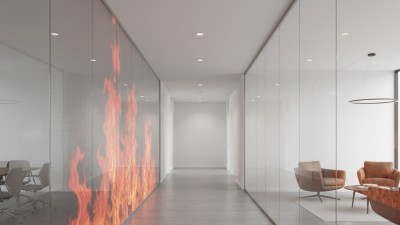
Fire-rated glass is not simply thicker safety glass. Its performance depends on heat, flames, smoke, and radiant energy. In practice, the protection level must match the wall, door, or partition around it.
A product labeled E usually maintains integrity against flames and hot gases.
EI adds insulation, limiting heat transfer to the protected side.
EW controls radiant heat, but its permitted use depends on the applicable standard. These letters are not interchangeable. Read the test evidence.
When choosing glass in 2026, request the complete tested assembly, not a loose pane. The frame, setting blocks, seals, beads, and hardware can change the result. Check the declared duration, such as 30, 60, or 120 minutes. Confirm whether the rating covers doors, screens, or façades.
Site conditions matter. A bright lobby may need lower glare, while an escape route needs clear visibility. The complete assembly may also require a certified smoke-control classification. In project reviews, designers sometimes specify “fire glass” without naming the required class. That shortcut creates expensive revisions. It is an easy mistake.
Use current certificates, installation instructions, and traceable test reports from qualified suppliers. Confirm that the assessment applies to the exact dimensions, support construction, and glass orientation. Local building officials or a competent fire engineer should verify the selection.
Do not treat marketing language as certification. Recheck every substitution. A small change in sealant or frame depth may invalidate the tested arrangement. The honest answer can be uncomfortable: the cheapest compliant-looking option may not be compliant at all.
How to Choose Fire Rated Glass in 2026?
Assessing Building Codes, Fire Risks, and Project Requirements
Choosing fire-rated glass in 2026 starts with the building code, not the product catalogue. Confirm the adopted code edition, occupancy type, fire compartments, and required rating with the authority having jurisdiction. A hospital corridor, a stair enclosure, and a retail façade may face different performance demands. The same label cannot solve every condition. Check whether the opening needs fire integrity, insulation, or limited radiant heat transmission. These terms are related, but they are not interchangeable.
Assess the actual fire risk around each opening. Look at fuel load, evacuation routes, smoke movement, impact exposure, and access for emergency crews. A glazed door beside a kitchen needs different scrutiny from a protected interior screen. Confirm the tested assembly, including glass, frame, setting blocks, seals, beads, and hardware. Fire performance belongs to the complete system. Do not rely on glass thickness alone. In practice, drawings often show the pane but omit the frame condition. That omission can undermine an otherwise careful specification.
Project requirements then shape the final choice. Review daylight, visibility, thermal movement, acoustic control, security, cleaning, and replacement access. Ask for current test evidence, classification reports, installation limits, and maintenance instructions. A qualified designer or fire consultant should verify compatibility with the wall and frame construction. Local approval remains essential. It is tempting to choose the highest rating everywhere, but that may add weight, cost, and unnecessary complexity. A better decision matches verified performance to the documented risk. I would still leave room for review. Site conditions change, and assumptions sometimes fail.
How to Choose Fire Rated Glass in 2026?
Comparing fire-rated glass types, ratings, and performance requires more than reading a minute rating. NFPA reported 1,504,500 fires in the United States during 2023, causing about $22.3 billion in property damage. These figures make assembly-level performance impossible to ignore. A 60-minute pane may not provide a 60-minute opening when the frame, seal, and wall are mismatched.
Fire-protective glass usually limits flames and smoke. It may not block dangerous radiant heat. Fire-resistive glass also controls heat transfer, often through multilayer or intumescent construction. Common ratings include 20, 45, 60, 90, and 120 minutes. Under EN 13501-2, classifications such as E, EW, and EI describe integrity, radiation control, and insulation. Under North American practice, testing may involve UL 10C, NFPA 252, ASTM E119, or UL 263, depending on the application.
The frame matters.
In a corridor, look beyond the glass thickness. Check the tested vision panel size, glazing direction, hose-stream performance, and edge conditions. A 2024 industry report from the National Glass Association notes that specification errors frequently involve compatibility between glass, framing, and installation details. That warning deserves attention. I still find rating labels easy to overtrust. Ask for the complete tested assembly, not only a product data sheet. Also verify impact safety, acoustic needs, daylight transmission, and thermal movement before approval.
| Glass Type | Typical Fire-Resistance Range | Primary Performance | How It Works | Optical Appearance | Common Applications | Main Advantages | Important Limitations |
|---|---|---|---|---|---|---|---|
| Wired Glass | Commonly 20–60 minutes, depending on the tested assembly | Primarily fire integrity; insulation performance is limited unless specifically tested | A wire mesh helps retain fragments when the glass cracks during fire exposure | Visible wire grid; textured or patterned options are common | Doors, partitions, borrowed lights, and protected openings where a traditional appearance is acceptable | Established technology; can provide economical fire integrity in suitable frames | Wire does not make ordinary glass fire-rated by itself; impact-safety and code requirements must be checked separately |
| Ceramic Glass | Commonly 20–180 minutes in tested systems | High-temperature stability; may provide integrity and, in some systems, insulation | Low thermal expansion and high temperature resistance reduce cracking and failure during fire exposure | Usually clear or lightly tinted; may have visible surface distortion depending on manufacturing method | Vision panels, doors, sidelites, partitions, and façade areas requiring high heat resistance | Excellent temperature resistance; suitable for demanding fire exposures when correctly specified | A high fire rating does not automatically provide insulation or impact safety; edge protection and framing remain critical |
| Intumescent Laminated Glass | Commonly 30–120 minutes, depending on layer construction and system testing | Can provide integrity and insulation; higher classifications require specific test evidence | Transparent interlayers expand and become opaque, insulating foam-like barriers when heated | Clear before fire; the interlayer typically becomes opaque or translucent during fire exposure | Internal partitions, glazed doors, stair enclosures, corridors, atria, and high-visibility fire separations | Can combine fire protection with good daylight transmission and acoustic performance | Sensitive to incorrect storage, edge damage, moisture exposure, and unapproved frame or glazing details |
| Multi-Layer Fire-Resistant Glass | Commonly 60–120 minutes; some tested assemblies achieve longer periods | Designed to provide both fire integrity and insulation for extended durations | Multiple glass panes and fire-resistant interlayers build a heat-insulating barrier as temperatures rise | Generally clear before fire; may have slight color, haze, or reflection from multiple layers | Large glazed walls, curtain-wall zones, high-rise compartments, protected escape routes, and security-sensitive areas | Strong combination of insulation, safety glazing potential, acoustics, and design flexibility | Heavier and thicker than ordinary glazing; requires compatible framing, supports, setting blocks, and installation tolerances |
| Fire-Rated Insulating Glass Unit | Commonly 30–120 minutes, depending on construction and tested configuration | Fire integrity plus reduced heat transfer; may also offer thermal and solar-control performance | Combines fire-resistant glazing with multiple panes, cavities, coatings, or intumescent layers | Can be clear, low-reflective, tinted, or coated, subject to the certified product configuration | Exterior façades, curtain walls, windows, and areas requiring both fire protection and energy performance | Supports daylighting, insulation, solar control, and façade design requirements in one assembly | Glass, spacer, sealant, pressure plate, mullion, and anchorage must match the tested or approved system |
| Fire-Rated Safety Laminated Glass | Typically 20–120 minutes, subject to the fire test and impact classification | Fire resistance combined with fragment retention and impact-safety performance | A laminated interlayer holds broken glass together while fire-resistant layers maintain the required barrier | Usually clear before fire; visual quality depends on interlayer type, thickness, and manufacturing quality | Doors, schools, hospitals, public buildings, circulation routes, and locations with high human impact risk | Addresses both fire separation and everyday human-impact hazards when certified for both uses | Fire rating and impact rating are separate properties; both must be documented for the complete installation |
How to Choose Fire Rated Glass in 2026?
Fire-rated glass should be selected from tested evidence, not appearance. NFPA’s Fire Loss in the United States During 2023 reported about 1.5 million fires and $22.9 billion in direct property damage. These figures make documentation more than paperwork. They show why a decorative panel cannot replace a verified fire-resistance system.
Check which standard supports the claimed performance. ASTM E119, UL 10C, EN 1364-1, and EN 1634-1 address different test conditions and classifications. Do not compare an integrity rating with an insulation rating. Read the test report carefully. It should identify the glass type, maximum dimensions, framing system, glazing materials, exposure time, and installation method. Some assemblies also require hose-stream testing.
A certificate alone can mislead.
Request a current certificate, classification report, product data sheet, installation guide, and traceability information. The paperwork should match the exact assembly on site, including frame depth and setting blocks. Certification from an accredited body adds confidence, but it does not approve every possible installation. In practice, this is where errors happen. A familiar-looking frame may have a different thermal movement or sealant requirement. I would also check revision dates and project-specific limitations before ordering. Documentation is not perfect, and older reports may remain in circulation. That deserves a second look.
How to Choose Fire Rated Glass in 2026?
Selecting fire-rated glass in 2026 starts with the wall, not the sample. Confirm whether the opening needs a fire-protection or fire-resistance rating. The required performance may cover integrity, insulation, radiant heat, or all three. Match the glass, frame, sealants, and hardware to one tested assembly. Do not combine attractive parts from unrelated systems. The 2024 International Building Code and current NFPA 101 editions remain useful references, but local authorities may enforce different editions.
The risk is measurable. NFPA’s Fire Loss in the United States During 2023 reported approximately 1,388,500 fires, 3,670 civilian deaths, and 23.3 billion dollars in direct property damage. These figures support careful specification, especially in corridors, stair enclosures, healthcare spaces, and high-occupancy buildings. Confirm the test standard, such as ASTM E119, UL 10C, NFPA 257, or EN 13501-2, according to the project’s jurisdiction. Check the actual classification.
Installation deserves equal attention. The approved frame must match the glass rating and size limits. Follow the tested system’s edge clearances, setting blocks, glazing tape, and sealant requirements. Protect the glass from chipped edges and construction debris. Never drill, cut, or alter it on site unless the tested design permits that work. Labels and documentation should remain visible for inspection.
A common mistake is trusting a product brochure alone. It may omit temperature limits or framing conditions. Field reviews often find small gaps, incorrect spacers, or unapproved substitutions. Those details matter. My own preference is cautious: verify every interface, photograph concealed work, and ask the manufacturer’s technical representative for written confirmation. Perfect specifications still depend on imperfect buildings.
Selecting, specifying, and installing the right glass according to tested fire-resistance duration.
Fire-resistance periods are commonly specified in 30-minute increments, including 30, 60, 90, 120, and 180 minutes. “E” classifications address integrity, while “EI” classifications address both integrity and insulation under the applicable fire-test standard. Select the required duration and classification from the project’s code, tested glazing assembly, framing system, and installation requirements.
Whether you’re looking for fire-rated walls, doors, openings, floors or a specialty service, we have the solution for you. With over 40 years of experience in testing, innovating, and providing technologically advanced fire-rated glass and framing products, we deliver unyielding performance and quality at a competitive price.